Tuesday, September 12, 2017

Geography of Genius: A Book Review


Book review written by Melissa Miller

This paper reviews:

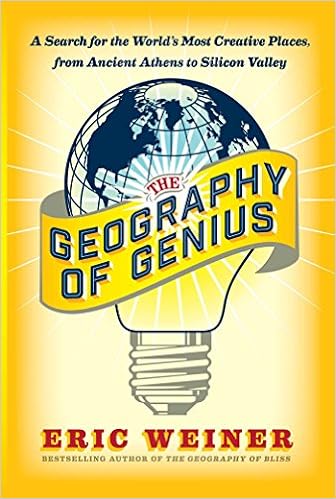
Weiner, E. (2016). The geography of genius: A search for the world's most creative places from ancient Athens to Silicon Valley. New York, NY: Simon & Schuster.

In the Geography of Genius Eric Weiner travels the world to explore the past in the present time at places where legendary creative geniuses lived. He explores the places where creativity occurred to gain insight into what influences the creative person. This book provides a unique perspective as a historical travel book about creative people and the places where they lived. 

Weiner provided the following quote by Pablo Picasso, which captures the timeless work of the creative geniuses:. “There is no past or future in art. If the work of art cannot live always in the present, it must not be considered art at all. The art of the Greeks, of the Egyptians, of the great painters who lived in other times, is not art of the past, perhaps it is more alive today than it ever was.” (p. 35). This quote represents the perspective taken by Weiner as he explored in the present time to look into the lives of timeless creative geniuses of the past. 

As Weiner traveled to various cities around the world, he fantasized about what it was like in Athens when Aristotle was alive, Florence during Michelangelo’s time, Calcutta during Bose’s time and many others. He also fantasized about how the geniuses might have responded in a conversation with him.  I am not one for fantasy or rambling speculation and would have greatly appreciated if Weiner would have gotten to the point. Weiner met with an acquaintance living in each city to discuss their perspective on the history of the city and the creative geniuses who called the city home. As Weiner contemplated the daily activities of historical creative geniuses, he stated, “History is the untallied sum of a million everyday moments.” (p. 15).

A main theme of this book is provided by a quote from Plato, “What is honored in a country will be cultivated there.” (p. 62). Weiner connects the development of the field of medicine in Edinburgh to the development of technology in Silicon Valley to explain that the demand for and/or tolerance of certain types of creativity in an area promotes the development and emergence of specific types of creativity in those areas. This connection provided me with some insight into why certain types of creativity are concentrated in various places. Creativity is more likely to occur in places where ideas are well received. Weiner contends that the creative person must be a good fit with their environment in order to recognize their full potential in their chosen domain, which explains why tech gurus are drawn to Silicon Valley. 

Weiner makes frequent reference to current creativity scholars such as Dean Keith Simonton, Mihaly Csikszentmihalyi and Howard Garder to substantiate some of his speculations about the creative person.  Creative people in creative cities tolerate diversity of thought, diversity of cultures and celebrate ambiguity. Exposure to diversity affords the creative person with opportunities to connect seemingly unrelated things.  Weiner believes imperfect conditions and a level of chaos inspire creativity.  Weiner further explains how we are most innovative when a challenge is present. He makes reference to Michelangelo carving David from a piece of marble that other artists had discarded of as defective to validate his point. The book highlights the link between creativity and openness of the individual to experience, various domains of knowledge, and perseverance in their quest to create. 

Some great quotes from the creative geniuses mentioned in this book include:

“Recognizing your ignorance is the beginning of all wisdom.” Socrates (p. 289)

“If we knew what we were doing, we wouldn’t call it research.” Albert Einstein (p. 158)
 
“Chance favors the prepared mind.” Louis Pasteur (p. 209)

As a student at the International Center for Studies in Creativity, I strongly disagree with Weiner’s perspective on teaching creativity and brainstorming. Weiner stated, “The straightjacket of a curriculum tends to bind the imagination.” (p. 179). He firmly believes creativity cannot be taught and makes no attempt to substantiate his position. Weiner stated, “Brainstorming sounds like a great idea, but it doesn’t work. Dozens of studies have demonstrated this conclusively.” (pp. 254-255). Weiner does not reference a single study to support his opposition to the efficacy of brainstorming and he does not mention Alex Osborn even once in the book. 

I would not recommend this book as a valuable contribution to the field of creativity.  Most of the book consisted of dialog between Weiner and his acquaintances around the world as well as fantasies about what each city he visited might have been like when the creative geniuses were there. It would have been more interesting if Weiner would have substituted his fantasy with relevant information about the cities and the creative geniuses who lived there. 


Melissa Miller is completing her MS in Creativity and Change Leadership at the International Center for Studies in Creativity this semester. Melissa holds the position of nursing lab coordinator for Genesee Community College. Melissa’s background is diverse with years of experience in a variety of domains including healthcare simulation, veterinary, research, academic advising, and counseling. Melissa is an experienced creative problem solving facilitator. Melissa's background includes teaching children, adults and college students in a variety of settings from 1:1 instruction to group instruction and from classroom to experiential settings. Melissa enjoys travel, hiking, scuba diving and photography to capture images of life underwater and on land focusing on plants, animals and natural landscapes.

Wednesday, July 5, 2017

Book Review: The Secret of the Highly Creative Thinker


Book Review written by Yves De Smet
This paper reviews
Nielsen, D., & Thurber, S. (2016). The secret of the highly creative thinker: How to make connections others don't. Amsterdam, The Netherlands: BIS Publishers.
In the foreword, Gerard J. Puccio nicely catches the purpose of the book: “… the strategies and exercises in this book promote exactly that: creativity on demand. Why wait for the muse? Learn to take responsibility for your own creativity.” (Nielsen & Thurber, 2016).
Summary of the content
The book is non-fiction and aims to educate the reader about why making connections is such an important skill in the grand scheme of creative thinking, and how people can go about getting better at making those connections. The value of this popular scientific work is not so much in the newness (making connections and its value in creativity is quite understood) as in the nice summary it presents of the subject, and in the 21 hands-on creativity exercises (the authors call it a boot camp) in the second half of the book. The latter is a great set of options for the divergent part of any reader’s next CPS session. The illustrations and format of the book make it very easy and pleasant to read.
There are 4 parts to the book:
1.     The nature of seeing connections (more or less the introduction to the subject)
2.     The theories behind it all (i.e., behind connections)
3.     Enhancing your innate creativity (exercises)
4.     Putting connections to work (classic connection-making tools)

Reactions, critical analysis, takeaways
·      Never judge a book by the cover… but how about judging it by the title? As a master’s student in creativity, it is so tempting to fall in love with this book by a mere look at its title. “The secret of …” appeals to one’s curiosity, “the highly creative thinker” to one’s vanity. The random book shopper in a vain, curious mood is likely to buy this book.
·      If one is intrigued by or interested in tools like ‘forced connections’ and ‘visual connections’, then this book should be on her or his shelf.
·       The very original images and photographs as intermezzos throughout the book are often brilliant examples of connections. See the Appendix 1 for four fun examples.
·     This book presents a very useful overview of work from the 1930’s to today about how connections have been considered important to creativity. James Web Young, W.I.B Beveridge, and Arthur Koestler are only some of the writers that are mentioned. There are likely only very few such elaborated pieces of literature that deal with this topic.
·      Favorite quotes:
o   P. 23: “When the winds of change blow, some build walls others build windmills. Old Chinese proverb.
o   P. 34: “If you look at history, innovation doesn’t come just from giving people incentives; it comes from creating environments where their ideas can connect.” Steven Johnson.
o   P. 44: “Creativity is just connecting things.” Steve Jobs.
o   P. 66: “In terms of creative connections, divergent thinking is when you connect to possibilities. Convergent thinking is when you connect the most promising possibilities to your goal.”
o   P. 116: “What do you get when you cross a cow with a trampoline?”
·      There is good list of references in the bibliography of this book. The following articles were very interesting to look into: (Dietrich, 2007) (Mednick, 1962, Vol. 69, No. 3) (Sawyer, 2011) (Vincent, Decker, & Mumford, 2002) .
·        The tool on p. 112-113 (see Appendix 2) is a great member of the visual connections family of techniques. Easy to use, and bound to generate a smile on any user’s face. 
Fast Facts
Hardcover: 176 pages                                                 ISBN-10: 9063694156
Publisher: BIS Publishers (June 28, 2016)                ISBN-13: 978-9063694159
Language: English                                                      Amazon price: $ 22.88
Authors (Dorte Nielsen, n.d.), (Sarah Thurber, n.d.)
Both authors hold a Master of Science in Creativity from the International Center for Studies in Creativity; they graduated together in 2012.
Dorte Nielsen (Danish) is creativity author, keynote speaker and founder of Creative Communication and FourSight Denmark. She has worked in the advertising sector and lately she has been active in education, teaching creativity at the Danish School of Media and Journalism. She is also the (co)author of The creative thinker’s exercise book (2017), The divergent and convergent thinking book: How to enhance your creative thinking, an exercise book (2017), The secret of the highly creative thinker (2014), Inspired: How creative people think, work and find inspiration (2011), Creativity unbound – An Introduction to creative process (5th edition, 2011), and of Facilitation – A door to creative leadership (4th edition, 2011).
Sarah Thurber (American) is managing partner of FourSight in the US.  She specializes in developing research-based tools to enhance innovation and team performance, mostly directly related to the FourSight Thinking Profile.  During her Master’s degree Sarah developed the Your two-minute thinking tip video series, to share creativity tips via social media. Sarah is co-author of Creativity unbound – An introduction to creative process (5th edition, 2011), and of Facilitation – A door to creative leadership (4th edition, 2011).


References
Dietrich, A. (2007). Who’s afraid of a cognitive neuroscience of creativity? Methods, 42, 22-27.
Mednick, S. A. (1962, Vol. 69, No. 3). The associative basis of the creative process. Psychological Review, 220-232.
Nielsen, D., & Thurber, S. (2016). The secret of the highly creative thinker: How to make connections others don't. Amsterdam, The Netherlands: BIS Publishers.
Sawyer, K. (2011). The cognitive neuroscience of creativity: A critical review. Creativity Research Journal 23:2, 137-154.
The art of observation: Elliott Erwitt. (n.d.). Retrieved from Faded & Blurred: http://fadedandblurred.com/elliott-erwitt/
Thurber, S. B. (2012). The million-click thinking tip. Creative Studies Graduate Student Master's Projects. Paper 163.
Vincent, A. S., Decker, B. P., & Mumford, M. D. (2002). Divergent thinking, intelligence, and expertise: A test of alternative models. Creativity Research Journal 14:2, 163-178.


 Book Review completed by Yves De Smet
•       Born in 1972 and living in Flanders, Belgium
•       Educational background
MSc Creativity and Change Leadership – Buffalo , New York (USA)
MBA – Vlerick Business School, Leuven (BE) (2013)
PhD Physics – University of Brussels (BE) (1999)
MSc and Certified Teacher in Physics – University of Brussels (BE) (1995)
•       Career
20 years of global experience in the chemical industry with ICI, National Starch and Chemical, Celanese and Michelman. Career path: R&D, technical service, business development, marketing, innovation, business management, corporate development, technology platforms
•       Free Time
Family: married, with 2 children (Laurie and Lennert)
Community: Youth Coordinator in a Soccer Club
Self: study, reading and running


Monday, November 14, 2016

Book Review: Creativity – A New Vocabulary

by MaryBeth Zacharias

What are the relationships and actions that take place between Rhodes’ 4 Ps of creativity?  What needs to happen in order for a creative product to take hold or for it to be recognized as an innovation?  What is stopping solutions to society’s wicked problems—that are developed at the individual and community levels—from being adopted at the city, state, and even national level?  What roles do our visible and invisible institutions, our societal norms, ethos, and mores, play in creative change?

As the context in which I explore creativity expands—from the individual and teams to organizations, communities, cities and beyond—questions like these have surfaced.  During my first year of studies I gained a solid understanding of the individual, cognitive-side of creativity and how the creative process works within teams and organizations.  However, the social and inter/active-side—what in my mind is the “sociology of creativity”—was pulling at me. And after an earnest research, I ran across a book of scholarly essays that began to shed some light on the questions running through my mind.

Creativity – A New Vocabulary, edited by Vlad Glăveanu, Lene Tanggaard, and Charlotte Wegener, professors from Aalborg University in Denmark, is a compilation of 21 reflective scholarly essays written by the editors and ten of their colleagues. The authors of these essays, all with different focus areas within psychology, selected a concept from their own area of study, that was not traditionally associated with creativity, and explored the concept “to develop a new way of understanding creativity as a dynamic, relational, developmental phenomenon” (p. 6). (See Appendix for a full list of the concepts, authors, and their fields of study).

Why did Glăveanu and his colleagues decide to re-examine the vocabulary associated with creativity? From their viewpoint, the study of creativity has been dominated by the same framework for the past half-century, and this framework is focused on the person and his/her cognitive abilities. They believe creativity goes beyond an individual act and unfolds because of the interactions and relationships among people and their surroundings. Throughout the 21 chapters presented in Creativity – A New Vocabulary, the authors show us how creativity can be viewed as a continuous process and journey, with relationships that extend beyond person-to-person to include person-to-objects, -materiality, and -time.

What the authors in this book do so well is take familiar concepts, or concepts we may intuitively associate with the individual, and reframe them so that this focus is secondary, and the action, the movement, the relationship of these concepts are brought to the forefront and become the primary association to creativity.  Some examples include:

  • Charlotte Wegener, in the Upcycling chapter, makes the distinction between recycling (making something old new again) and upcycling, noting that “upcycling makes the relation between the past the future, not novelty itself, the main object of interest” in creativity (p. 183).
  • When reading the chapter on Craft, the reader gets a sense that the “a-ha!” moment or the final creative product is an afterthought, and it’s the “perspiration,” the time, energy, rewrites, experiments, failures, and hours of mastery that are the true mark of creativity.
  • A number of chapters focus on aspects of communication, in particular Language, Translation, and Perspectives.  This entry from the Perspective chapter provides a summary that includes underlying themes for each language concept: “...creativity is much more than generating new or divergent ideas as a purely cognitive exercise…it involves at all times the dialogue and movement between different socially and materially defined positions” (p. 109).
  • The emotion of Fear becomes a conduit for creativity as Luca Tateo explains how its relationship with signs, not knowing, and reification create frameworks for collective behavior and to build cultures.
  • And in one of the most profound entries for me, Reflexivity, the circular relationship between cause and effect, Saint-Laurent and Glăveanu propose that “we need to open our eyes to the social conditions of others and how we might be responsible for them” (p. 126) challenging me to incorporate reflexivity when facilitating divergent thinking during Creative Problem Solving (CPS) facilitations.

Though it was both enlightening and entertaining to read the authors reframed and expanded views on the various concepts—and then to play with the new knowledge myself—I was reminded that action and relationships are already accounted for in various theories, models, tools and techniques of creativity.  The authors brought forth a number of concepts that they deemed “missing” from creativity research that are represented in creativity as I have studied it.  One example is Affordance, which is a term used to describe all actions that are physically possible for an object. Glăveanu discusses how we see objects based on their purpose within our cultural context and to see beyond that purpose, as well as see the object as a deconstruction of its parts, has a place in creativity.  When reading this chapter, I thought of the similarities between Affordance and the CPS technique of Forced Connections as well as the Torrance Incubation Model (TIM) principles of Look at It Another Way and Visualize the Inside. Some of the dynamic concepts brought forth by Glăveanu et al hold a place in the current creativity paradigms, though they are not always as visible or pronounced, researched or studied as the psychological aspects.

I agree with the authors that creativity may be unevenly focused on the individual.  Reading the book reinforced with me how important relationships and action are to creativity. Yet, so are the various aspects of the individual.  Instead of replacing or prioritizing one over the other, I see them as complementary and believe there are opportunities and extraordinary benefits to surfacing elements of the social side of creativity within the current frameworks and models I use as a practitioner.

There were 21 different concepts presented in this book and each brought a unique dynamic, relational, and developmental perspective to creativity.  By simply reframing the concepts I started to think differently about creativity.  Many times the reframing was very nuanced, but just on the other side of the nuance was a profound insight that turned cognitive, emotional, and individual aspects of creativity into material, process, social, and cultural aspects of creativity. I am afraid this book review barely skims the surface on the richness and depth that was presented, and the potential implications for this perspective in the research and application of creativity.  This book is recommended for anyone who wants to dig deeper into the action and interaction associated with creativity and explore creativity from a non-traditional perspective.


MaryBeth Zacharias is completing the final year of her Master of Science degree in Creativity and Change Leadership at the International Center for Studies in Creativity.  She has particular interest in creativity and Creative Problem-Solving from a change and development perspective.

Friday, November 4, 2016

Book Review - Originals: How non-conformists move the world


Nineteen hours before the deadline of my “hot book in creativity” review, I finally began my writing. I have mixed feelings about my timing: I feel guilty for not getting productive until the last minute, but I’ve also learned to trust my procrastination to be the best way to crank a good blog post out of my brain…

What a blessing to learn that procrastinating is actually one of the effective strategies to deliver something original. Maybe not good for productivity, but wonderful for creativity. This was the perfect way for professor Adam Grant to win me over in his new book, Originals, flattering me even more by sharing that I’m in good company. Martin Luther King, Jr. was still writing his most important speech at three o’clock the night before delivering it. He kept rewriting until the minute he got on stage. Where he then improvised those four important words: “I have a dream”.

How is procrastination good for creativity? Leaving things open until the last minute keeps you flexible and open to new and better ideas. People that remain open to alternatives generate more original options than the obvious first ideas. The condition being, of course, that you use procrastination as a deliberate strategy for incubation. When you keep your task in the back of your mind and you keep open to it, you are more likely to diverge on ideas to solve your task while engaging in other activities. This diverging on ideas is only one aspect of what it takes to be an original.

Grant has spent years researching people he calls Originals. These are non-conformists who not only have ideas, but who also act on them. Grant defines them as the driving force behind creativity and change. Originality starts with curiosity, and Grant’s curiosity is exactly that what makes this book so original. Grant asks and researches questions that are so original that they shed a novel light on often-hidden aspects of creativity and originality. And last, but not least, Grant refutes several assumptions around creativity.

For those who are familiar with creativity research and literature, many aspects he considers are not new. But the extensive research and the great examples in the book deepened my knowledge on the topic and made me feel so much smarter. I now not only know the facts, but also feel better equipped to help myself and others act in more original ways. That’s why I urge you to read the book. As a sneak preview, here are some fascinating facts and myths that stood out for me.

Did you know that Apple users with Firefox and Windows users with Chrome browsers perform better than the ones using Safari and Explorer? This has nothing to do with performance of the software. It has to do with rejecting the default and exploring different options. Users who are critical and curious enough to take small actions, like downloading a new browser to use instead of the default Safari or Explorer, are more likely to also have novel ways of fixing issues for customers.

Action is what sets originals apart from others with great ideas. Originals often engage in the act of creative destruction, as doing things differently often requires demolishing the old way of doing things. This may lead you to the idea that originals can be ruthless risk-takers. In fact, they balance risk out with security.  or example, entrepreneurs are known for taking risks to launch their original ideas, but very successful entrepreneurs like Steve Jobs of Apple and the Google founders Larry Page and Sergey Brin have put their eggs in different baskets for years. Balancing risks in different portfolios allows room for originality. To be original in one area, you need emotional and social stability in others. This balance doesn’t mean being moderate in everything. It means taking extreme risks on one end and being extremely cautious on another.

Another myth that Grant wipes off the table is that the lack of originality is caused by the lack of novel ideas. Instead, it’s a matter of poor idea selection. It’s difficult to predict the success of novel ideas. You may know that one way to have original ideas is to have many ideas. But how can you forecast if an idea will become successful? Not through self-evaluation, as research shows that we overestimate our own ideas. Not through management, since managers are often risk averse. Nor through pilots, because the public needs time to get used to novel and unknown ideas. The best way is to get feedback from other creators in your domain. Ask different people in your domain to get diverse feedback.

As previously stated, it’s a smart move for originality’s sake to take time for idea generation. Waiting also proves to be an important survival strategy when marketing new products and services. We often hear how important it is to stay ahead of competition, but research shows that’s untrue. Historically, pioneers that have been the first to enter the market were six times more likely to fail than the slower-launching settlers who have entered the market created by the pioneers. This is because the latter could make investments that the market wasn’t ready to support in the times of the former.

In the second part of the book Grant shifts from individuals to groups. Along with effective communication strategies to help original ideas get embraced, and tips on creating allies (particularly with your “frenemies”), Grant warns about the danger of groupthink, the enemy of originality. Ray Dalio, CEO of the Bridgewater Investment Company, does everything in his power to avoid groupthink. Bridgewater promotes radical transparency to get the best ideas on the table for everybody to challenge. Where most leaders don’t want their employees to bring them problems, but instead encourage solutions, Dalio wants his employees to approach him with challenges, diagnose them, share their reasoning and explore the causes and solutions. A believability score system guards the quality of the problem solving.

The book has many more inspiring examples that help my ambition. Like Martin Luther King, Jr., I have a dream. Mine is to dissect my own originality and use the building blocks to help others unleash their originality. Grant helped me get a better insight in myself. Now it’s my turn to help others gain insight in what it takes for them to be original.

Anneke Veenendaal-de Kort is a master student at the International Center for Studies in Creativity at SUNY Buffalo State. Anneke holds a Master in communications in The Netherlands where she lives and works as a communications consultant. Anneke’s drive is to design inspiring communications concepts to move people to move their organization towards new, innovative or just inspiring goals. Before starting her Master, Anneke wrote and published a management cookbook with tasty recipes for creative communications in change.