Tuesday, September 12, 2017

Geography of Genius: A Book Review


Book review written by Melissa Miller

This paper reviews:

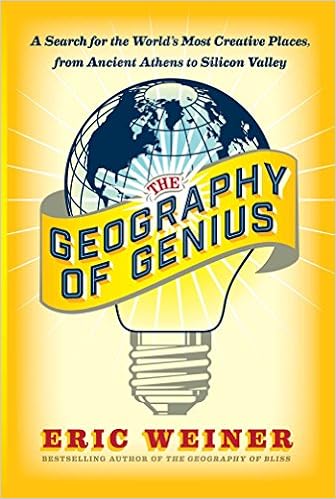
Weiner, E. (2016). The geography of genius: A search for the world's most creative places from ancient Athens to Silicon Valley. New York, NY: Simon & Schuster.

In the Geography of Genius Eric Weiner travels the world to explore the past in the present time at places where legendary creative geniuses lived. He explores the places where creativity occurred to gain insight into what influences the creative person. This book provides a unique perspective as a historical travel book about creative people and the places where they lived. 

Weiner provided the following quote by Pablo Picasso, which captures the timeless work of the creative geniuses:. “There is no past or future in art. If the work of art cannot live always in the present, it must not be considered art at all. The art of the Greeks, of the Egyptians, of the great painters who lived in other times, is not art of the past, perhaps it is more alive today than it ever was.” (p. 35). This quote represents the perspective taken by Weiner as he explored in the present time to look into the lives of timeless creative geniuses of the past. 

As Weiner traveled to various cities around the world, he fantasized about what it was like in Athens when Aristotle was alive, Florence during Michelangelo’s time, Calcutta during Bose’s time and many others. He also fantasized about how the geniuses might have responded in a conversation with him.  I am not one for fantasy or rambling speculation and would have greatly appreciated if Weiner would have gotten to the point. Weiner met with an acquaintance living in each city to discuss their perspective on the history of the city and the creative geniuses who called the city home. As Weiner contemplated the daily activities of historical creative geniuses, he stated, “History is the untallied sum of a million everyday moments.” (p. 15).

A main theme of this book is provided by a quote from Plato, “What is honored in a country will be cultivated there.” (p. 62). Weiner connects the development of the field of medicine in Edinburgh to the development of technology in Silicon Valley to explain that the demand for and/or tolerance of certain types of creativity in an area promotes the development and emergence of specific types of creativity in those areas. This connection provided me with some insight into why certain types of creativity are concentrated in various places. Creativity is more likely to occur in places where ideas are well received. Weiner contends that the creative person must be a good fit with their environment in order to recognize their full potential in their chosen domain, which explains why tech gurus are drawn to Silicon Valley. 

Weiner makes frequent reference to current creativity scholars such as Dean Keith Simonton, Mihaly Csikszentmihalyi and Howard Garder to substantiate some of his speculations about the creative person.  Creative people in creative cities tolerate diversity of thought, diversity of cultures and celebrate ambiguity. Exposure to diversity affords the creative person with opportunities to connect seemingly unrelated things.  Weiner believes imperfect conditions and a level of chaos inspire creativity.  Weiner further explains how we are most innovative when a challenge is present. He makes reference to Michelangelo carving David from a piece of marble that other artists had discarded of as defective to validate his point. The book highlights the link between creativity and openness of the individual to experience, various domains of knowledge, and perseverance in their quest to create. 

Some great quotes from the creative geniuses mentioned in this book include:

“Recognizing your ignorance is the beginning of all wisdom.” Socrates (p. 289)

“If we knew what we were doing, we wouldn’t call it research.” Albert Einstein (p. 158)
 
“Chance favors the prepared mind.” Louis Pasteur (p. 209)

As a student at the International Center for Studies in Creativity, I strongly disagree with Weiner’s perspective on teaching creativity and brainstorming. Weiner stated, “The straightjacket of a curriculum tends to bind the imagination.” (p. 179). He firmly believes creativity cannot be taught and makes no attempt to substantiate his position. Weiner stated, “Brainstorming sounds like a great idea, but it doesn’t work. Dozens of studies have demonstrated this conclusively.” (pp. 254-255). Weiner does not reference a single study to support his opposition to the efficacy of brainstorming and he does not mention Alex Osborn even once in the book. 

I would not recommend this book as a valuable contribution to the field of creativity.  Most of the book consisted of dialog between Weiner and his acquaintances around the world as well as fantasies about what each city he visited might have been like when the creative geniuses were there. It would have been more interesting if Weiner would have substituted his fantasy with relevant information about the cities and the creative geniuses who lived there. 


Melissa Miller is completing her MS in Creativity and Change Leadership at the International Center for Studies in Creativity this semester. Melissa holds the position of nursing lab coordinator for Genesee Community College. Melissa’s background is diverse with years of experience in a variety of domains including healthcare simulation, veterinary, research, academic advising, and counseling. Melissa is an experienced creative problem solving facilitator. Melissa's background includes teaching children, adults and college students in a variety of settings from 1:1 instruction to group instruction and from classroom to experiential settings. Melissa enjoys travel, hiking, scuba diving and photography to capture images of life underwater and on land focusing on plants, animals and natural landscapes.

Wednesday, July 5, 2017

Book Review: The Secret of the Highly Creative Thinker


Book Review written by Yves De Smet
This paper reviews
Nielsen, D., & Thurber, S. (2016). The secret of the highly creative thinker: How to make connections others don't. Amsterdam, The Netherlands: BIS Publishers.
In the foreword, Gerard J. Puccio nicely catches the purpose of the book: “… the strategies and exercises in this book promote exactly that: creativity on demand. Why wait for the muse? Learn to take responsibility for your own creativity.” (Nielsen & Thurber, 2016).
Summary of the content
The book is non-fiction and aims to educate the reader about why making connections is such an important skill in the grand scheme of creative thinking, and how people can go about getting better at making those connections. The value of this popular scientific work is not so much in the newness (making connections and its value in creativity is quite understood) as in the nice summary it presents of the subject, and in the 21 hands-on creativity exercises (the authors call it a boot camp) in the second half of the book. The latter is a great set of options for the divergent part of any reader’s next CPS session. The illustrations and format of the book make it very easy and pleasant to read.
There are 4 parts to the book:
1.     The nature of seeing connections (more or less the introduction to the subject)
2.     The theories behind it all (i.e., behind connections)
3.     Enhancing your innate creativity (exercises)
4.     Putting connections to work (classic connection-making tools)

Reactions, critical analysis, takeaways
·      Never judge a book by the cover… but how about judging it by the title? As a master’s student in creativity, it is so tempting to fall in love with this book by a mere look at its title. “The secret of …” appeals to one’s curiosity, “the highly creative thinker” to one’s vanity. The random book shopper in a vain, curious mood is likely to buy this book.
·      If one is intrigued by or interested in tools like ‘forced connections’ and ‘visual connections’, then this book should be on her or his shelf.
·       The very original images and photographs as intermezzos throughout the book are often brilliant examples of connections. See the Appendix 1 for four fun examples.
·     This book presents a very useful overview of work from the 1930’s to today about how connections have been considered important to creativity. James Web Young, W.I.B Beveridge, and Arthur Koestler are only some of the writers that are mentioned. There are likely only very few such elaborated pieces of literature that deal with this topic.
·      Favorite quotes:
o   P. 23: “When the winds of change blow, some build walls others build windmills. Old Chinese proverb.
o   P. 34: “If you look at history, innovation doesn’t come just from giving people incentives; it comes from creating environments where their ideas can connect.” Steven Johnson.
o   P. 44: “Creativity is just connecting things.” Steve Jobs.
o   P. 66: “In terms of creative connections, divergent thinking is when you connect to possibilities. Convergent thinking is when you connect the most promising possibilities to your goal.”
o   P. 116: “What do you get when you cross a cow with a trampoline?”
·      There is good list of references in the bibliography of this book. The following articles were very interesting to look into: (Dietrich, 2007) (Mednick, 1962, Vol. 69, No. 3) (Sawyer, 2011) (Vincent, Decker, & Mumford, 2002) .
·        The tool on p. 112-113 (see Appendix 2) is a great member of the visual connections family of techniques. Easy to use, and bound to generate a smile on any user’s face. 
Fast Facts
Hardcover: 176 pages                                                 ISBN-10: 9063694156
Publisher: BIS Publishers (June 28, 2016)                ISBN-13: 978-9063694159
Language: English                                                      Amazon price: $ 22.88
Authors (Dorte Nielsen, n.d.), (Sarah Thurber, n.d.)
Both authors hold a Master of Science in Creativity from the International Center for Studies in Creativity; they graduated together in 2012.
Dorte Nielsen (Danish) is creativity author, keynote speaker and founder of Creative Communication and FourSight Denmark. She has worked in the advertising sector and lately she has been active in education, teaching creativity at the Danish School of Media and Journalism. She is also the (co)author of The creative thinker’s exercise book (2017), The divergent and convergent thinking book: How to enhance your creative thinking, an exercise book (2017), The secret of the highly creative thinker (2014), Inspired: How creative people think, work and find inspiration (2011), Creativity unbound – An Introduction to creative process (5th edition, 2011), and of Facilitation – A door to creative leadership (4th edition, 2011).
Sarah Thurber (American) is managing partner of FourSight in the US.  She specializes in developing research-based tools to enhance innovation and team performance, mostly directly related to the FourSight Thinking Profile.  During her Master’s degree Sarah developed the Your two-minute thinking tip video series, to share creativity tips via social media. Sarah is co-author of Creativity unbound – An introduction to creative process (5th edition, 2011), and of Facilitation – A door to creative leadership (4th edition, 2011).


References
Dietrich, A. (2007). Who’s afraid of a cognitive neuroscience of creativity? Methods, 42, 22-27.
Mednick, S. A. (1962, Vol. 69, No. 3). The associative basis of the creative process. Psychological Review, 220-232.
Nielsen, D., & Thurber, S. (2016). The secret of the highly creative thinker: How to make connections others don't. Amsterdam, The Netherlands: BIS Publishers.
Sawyer, K. (2011). The cognitive neuroscience of creativity: A critical review. Creativity Research Journal 23:2, 137-154.
The art of observation: Elliott Erwitt. (n.d.). Retrieved from Faded & Blurred: http://fadedandblurred.com/elliott-erwitt/
Thurber, S. B. (2012). The million-click thinking tip. Creative Studies Graduate Student Master's Projects. Paper 163.
Vincent, A. S., Decker, B. P., & Mumford, M. D. (2002). Divergent thinking, intelligence, and expertise: A test of alternative models. Creativity Research Journal 14:2, 163-178.


 Book Review completed by Yves De Smet
       Born in 1972 and living in Flanders, Belgium
       Educational background
MSc Creativity and Change Leadership – Buffalo , New York (USA)
MBA – Vlerick Business School, Leuven (BE) (2013)
PhD Physics – University of Brussels (BE) (1999)
MSc and Certified Teacher in Physics – University of Brussels (BE) (1995)
       Career
20 years of global experience in the chemical industry with ICI, National Starch and Chemical, Celanese and Michelman. Career path: R&D, technical service, business development, marketing, innovation, business management, corporate development, technology platforms
       Free Time
Family: married, with 2 children (Laurie and Lennert)
Community: Youth Coordinator in a Soccer Club
Self: study, reading and running