Showing posts with label creativity book. Show all posts

Sunday, September 23, 2012

The Tools: Transform your problems into courage, confidence, and creativity. A Book Review by Graduate Student Ian Rosenfeldt.


I came across The Tools in the Cultural Studies section of the bookstore. After flipping through, it looked appealing enough to investigate. The premise is straightforward - outlining five tools to be used to develop one’s self actualization. It occurred to me that there are plenty of cognitive tools to guide creative thinking and yet I hadn’t come across many whose purpose was to guide our thoughts so as to optimize our mindset for creative thinking. How do we suspend judgement? How do we accept opinions even if we disagree with them? Since the elements of courage and confidence are fundamental to developing creativity, perhaps The Tools, developed by Phil Stutz and Barry Michels, would show a path to do just that and more?

Chapter one is written in call-and-response style from each author. One talks about his experience as a psychotherapist, encountering challenges with patients and looking for answers himself. The other talks about being approached by a young patient who was searching for answers. Not to why she thought the way she did, but on how to change her way of thinking. This led Barry Michels on his own quest to find tools that could do just that. The historical perspective on how the authors came to be acquainted with each other and the Tools made for an easy an engaging read and heightened my anticipation for more.

The tools are a way to bring positivity to your consciousness and to connect you to something called the Higher Power (and yes, it’s capitalized in the book). When first reading about the Higher Power, skepticism came naturally. The authors invite skepticism and ask only for one thing - for the reader to practice the tools. Given that simple request, I read on with an open mind, curious about what lay behind these Higher Powers. By inviting skepticism, the reader is forced to examine the book from deeper perspectives, to be open minded and yet look for cracks in the process.

Each of the next five chapters, one for each of the tools, starts with a story from their experiences - giving personality and context to allow the reader to identify with. They present situations that would prompt you to use the tool, the higher force that you will connect with, the process on how to use the tool (with simple illustrations), how the tool works and what the benefits are. The authors also address frequently asked questions they’ve had for each tool before ending off with a summary. This layout works very well. As I progressed through each chapter, I was trying to identify how I would use each tool. As each chapter summary drew near, there were additional examples given and alternative uses offered. Many of my own questions were addressed.

Thus far, I was grateful for finding The Tools and yet, the chapter on Higher Power was yet to come and my skepticism alarm started to chime. Turns out the Higher Power is not meant as a concept to challenge or replace anyone’s god, religion or spiritual belief. It offers a way of explaining how the power of happiness and confidence is actually a never ending well that we can tap into...only it comes from inside of us and not from external sources. To paraphrase the authors - these tools are a means of defeating inner enemies, using the weapons that enable us to believe in and experience higher forces without sacrificing our mental freedom to anyone or anything.

Despite my skepticism, I realized that the perspective presented isn’t revolutionary or even that scary. What is unique about this book is how the tools and this unique perspective of Higher Powers are presented, in an easily digestible way with simple and plain language that is not steeped with cultural, religious or spiritual dressings.  I found its simplicity and presentation refreshing, and after some short term practice I can say that these tools have had a positive impact on me. More practice is in the cards, most definitely.

The concluding chapter espouses practice and has us consider what might happen if more and more people tapped into these Higher Powers - how we as a society could benefit from the resulting positivity. One theme underscoring the entire book is that Western society is hell bent on consumption as a route to happiness, as if the latest and greatest will allows us to harness our creativity and confidence even better than before. What Stutz and Michels stress, however, is that along with developing a more positive mindset we each have the limitless power to develop our own creative selves. In effect, creating is more powerful than consuming.

Reading between the lines, it is not a far cry to draw connections to humanistic psychologists such as Rollo May or Abraham Maslow. The field of positive psychology is there as well, with the elements of motivation that could have easily referenced Teresa Amabile and Mihaly Csikszentmihalyi and even psychologist Viktor Frankl.

Reaction
The tools seem like mantras, images and stories to be repeated and experienced repeatedly in one’s head. What is most interesting is that we’re not being told what specific images to use (i.e. not of someone else's creation) but scenarios to create ourselves, based on our own experiences, insecurities, goals and wishes. It takes imagination to visualize these future scenarios and The Tools calls upon our metacognitive efforts to practice them.

The authors mainly draw upon their experiences as psychotherapists in developing these tools. It was disconcerting as a reader to have no references to draw upon, and yet a core tenant of the book is that having faith in a process despite not being able to prove it, doesn’t detract from its effectiveness. Getting through the book is pretty easy, so I encourage a temporary suspension of judgement while you read it. Once through the book, having gained an understanding of the tools themselves, the concept of Higher Powers may be easier to digest and reformulate in a way that makes more sense to you.

I would recommend this book to anyone who is craving an infusion of fresh perspective to their stale inner dialogue. If you’re looking for techniques to be used to top up your positivity, courage and confidence then The Tools is worth further investigation.


About Ian
Ian is an energizing facilitator of deliberate creativity, team training and Creative Problem Solving. He is a specialist in coaching for success, providing the tools to optimize creative thinking and facilitating diverse groups through their unique challenges.
Ian is a current Masters student at Buffalo State College, studying creativity, innovation and change leadership. He pursues optimal experience in the mountains (not often enough), on bikes of all sorts and behind two turntables. 

Sunday, September 16, 2012

Book Review: Turning Pro: Tap Your Inner Power and Create Your Life’s Work By Steven Pressfield

Description: Turning Pro: Tap Your Inner Power and Create Your Life's Work

Turning Pro: Tap Your Inner Power and Create Your Life’s Work By Steven Pressfield


Pressfield, S. (2012). Turning Pro: Tap Your Inner Power and Create Your Life’s Work. New York: Black Irish Entertainment, LLC.

Would-be rockers might argue Born to Run is one of the greatest albums of all time; easily Bruce Springsteen’s opus. This marked the turning point in his career when he made the decision to commit his energy and talent to the universe.  Indeed, some of the most haunting and powerful lyrics on the album lie in the song Thunder Road, “the door is open but the ride, it ain’t free.”  According to the boss himself, “so this was my big invitation to my audience, to myself, to anybody who was interested.  My invitation to a long and earthly, very earthly, journey.  Hopefully in the company of someone you love, people you love, and in search of a home you can feel a part of” (Springsteen, 2005). 
Turning Pro by Steven Pressfield, is a non-fiction book about the seminal moment when an individual makes, what Pressfield calls, “a monumental, life-overturning decision” (Pressfield, p. 5).  In other words, the moment one makes the decision to stop fooling around, to become the creative person he was born to be; the point in which one draws a line in the sand. Springsteen’s storytelling encapsulates Pressfield’s thesis regarding why some individuals are able to embrace their true creative calling in life, while others merely tip- toe along the edges, seeking distractions to silence that tiny voice inside. It’s not easy to turn pro.  Yet at the same time, it’s much more difficult, and mentally painful not to.
Reading Turning Pro is not about identifying a true calling. Pressfield asserts that for the amateur it’s already there, hiding under the surface. Rather, Pressfield suggests there is a stark difference between the amateur and the professional and dedicates the book comparing and contrasting the mindset and behaviors of the two archetypes. He purports turning pro – consciously leaving the amateur behind – represents a model for self-transformation (Pressfield, p. 5).   
Self-transformation begins by acknowledging and pushing through what Pressfield terms, “resistance,” a force of fear, self-doubt and self-sabotage.  The amateur allows resistance to stymie creativity, by providing all too tempting distractions.  For some it might be addictions to food, alcohol or even making money.  To others, resistance takes the form of the need for instant gratification or the approval of others.  According to Pressfield, “addictions take on two primary characteristics: they embody repetition without progress and they produce incapacity as a payoff.”  Addictions are boring; they travel in a repetitious circle that goes nowhere.  “We are stuck in the same endlessly repeating loop. That’s what makes addiction like hell” (Pressfield, p. 34).  
The professional faces the same types of resistance; the difference being he recognizes it for what it is and has committed to stepping through it. Being a professional is an act of courage. “The professional knows that in the course of her pursuit, she will inevitably experience moments of terror, even panic. She knows she can’t choke that back or wish it way. It’s there, it’s for real.”  (Pressfield, p. 123).
The Pressfield suggests the professional gets to this place because of a commitment to mastery, to leaving the trappings of the amateur. Turning Pro is not easy. Turning Pro means, in a sense, growing up, leaving youth (metaphorically) behind.  It may necessitate finding a new set of friends, a new career, a new way of life.  In other words, “the ride, it ain’t free.”  Old, comforting habits must be jettisoned.
The book has a touch of “zen.” Turning professional leads to a more spiritual place with one’s art (however defined), by finding one’s personal power. Ironically, turning pro is not easy, but being pro is. Pressfield (p. 90 – 91) does a wonderful job of bluntly stating the qualities of the professional, who:
·       Shows up everyday
·       Stays on the job all day
·       Is committed over the long haul
·       Knows the stakes are high and real
·       Is patient
·       Seeks order
·       Demystifies
·       Acts in the face of fear
·       Accepts no excuses
·       Plays it as it lays
·       Is prepared
·       Does not show off
·       Dedicates himself to mastering technique
·       Does not hesitate to ask for help
·       Does not take failure or success personally
·       Does not identify with his instrument
·       Endures adversity
·       Self-validates
·       Reinvents herself
·       Is recognized by other professionals

In Summary – Relationship To Creativity
Turning Pro is not a guide to finding one’s artistic (big C, little c) calling.  For this type of personal journey, I recommend Sir Ken Robinson’s, “The Element.” Dr. Robinson asserts The Element is found at the intersection of natural aptitude and personal passion (Robinson, p 21). Pressfield targets the individual who hears his calling yet is scared to act. The person who may, on a conscious or sub-conscious level, know the pain of not changing is greater than the pain of changing. 
As students of creativity, Pressfield lays out the very simple choice – we can sit on the sidelines and dabble in Creative Problem Solving and creative leadership or fight our way into the game, grab the ball and run like heck to the goal post.  We must choose to lead creatively.  We must declare ourselves creative leaders and own it.
The book is a quick, yet powerful read that I found to be very self-motivating. It has evolved my thinking on creativity, offering insight regarding the blocks to creative commitment. For readers, the idea of naming the force of resistance and identifying it on a personal level might evoke a new level of self-awareness, leading to self-transformation.  
Those interested in the concept of resistance and its relationship to developing one’s creative calling should consider reading Pressfield’s 2002 work, The War of Art.

About the Author
Steven Pressfield is the author of Gates of Fire, Tides of War, The Afghan Campaign, The Profession, The Warrior Ethos and The War of Art.


References

Aronica, L., and Robinson, K. (2009). The Element: how finding your passion
changes everything. New York: Penguin Group.

Robinson, K., and Aronica, L. (2009). The Element: how finding your passion
            changes everything. New York: Penguin Group.

Springsteen, B. (1975). Born to Run. New Yor: Columbia Records.

VH1 (April, 23, 2005). Storytellers: Bruce Springsteen. Distributed by Viacom
            International.   


Alison Murphy – Biographical Sketch 
Alison Murphy is a founding partner of Murphy Marketing Research/TRENDTOWN, an insights consulting firm dedicated to applying creativity tools to traditional market research methods. Alison and her husband, Tom, formed the company 18 years ago and employ six professionals.  Throughout her career, Alison has worked with Fortune 100 consumer and business-to-business organizations.  She works closely with clients including Grainger, Allstate Insurance and Revlon to gain insight, identify customer needs and develop new products and marketing and advertising programs.  
Areas of expertise include developing innovative and creative methodologies for capturing consumer insights on deeper, more emotive levels and facilitating ideation and brainstorming sessions.  Throughout her career, she has moderated hundreds (and hundreds) of focus groups.  
A specific area of accomplishment is MMR/TT’s Sparks® ideation program that features a panel of over 400 creative consumers who brainstorm new products for leading manufacturers.   In 2012, the Sparks® program won a coveted Ogilvy Award for Innovation Excellence and in 2009, MMR/TT’s Sparks® program was awarded the Milwaukee Small Business Times IQ (Innovation Quotient) Award.  
Prior to forming MMR/TT, Alison worked for several leading advertising agencies in Chicago and Milwaukee and held the position of Market Research Director for Stokely USA, a division of Del Monte.  She holds a BA from the University of Wisconsin at Madison and an MA from Marquette University. 
As a life-long student, Alison is currently completing a Master of Science degree in Creative Studies and Change Leadership through SUNY New York.  She attends the annual Creative Problem Solving Institute (CPSI) sponsored by the Creative Education Foundation.  She is very active in the Qualitative Research Consultant’s Association, having served on the Board of Directors as Vice President for this global, 1,000 member organization.    In addition, she is involved in the PTA for her son’s high school and conducts strategic planning sessions for the school board. 
She’s a passionate bread baker (no bread machines allowed!) and recently won a blue ribbon for her Jackson Harbor Killer brownies at the Washington Island fair. 

Contact: Alison Murphy
Murphy Marketing Research/TRENDTOWN
161 North Green Bay Road
Thiensville, Wisconsin 53092
262-236-0194 ext. 229   amurphy@murphymarketing.com    www.murphymarketing.com 


Tuesday, January 25, 2011

Book Review: The Myths of Innovation


written by Graduate Student Rob Kubiak

Scott Berkun, through copious notes, interviews, and references, has put together a great book that debunks the myths of innovation. Throughout the book he uses myths and presents examples to help explain how innovation happens, or the factors involved which do not allow for innovation to happen. He also explores some of the reasons for why myths are popular and then provides insights on how to approach aspects of innovation without necessarily faltering along the way.

The book was a fun and enjoyable read for a variety of reasons. Each chapter Berkun explores one myth and brings examples from history into present-day analysis. The book begins with a preface that explains what his aims are for the book: (1) identify myths about innovation; (2) explain why they’re popular; and (3) explore and teach from the truth. His approach and writing style have a sense of humor to it. At times it brought a light chuckle, but at other times, I wish he would have stuck to some facts to drive home certain points rather than amuse himself with his own writing.

In the opening chapter, Berkun sets the stage for the book by explaining a recent tour he took at the Google headquarters. He tells the story of Google having various gadgets for employees to play with, having outlets for laptops in odd places like stairwells, and other descriptions of the Google environment that fosters creativity such as bean bag chairs, Ping-Pong tables, laptops, and Nerf toys. Two men who were on the tour take in the scene at Google and one man asks the other, “I see them talking and typing, but where do they come up with their ideas?”

This sets the stage for the premise of Berkun’s book. From that point forward, he take time in each chapter to debunk myths of innovation and uses stories of Newton’s “discovery” of gravity, Einstein’s approach to defining problems before working on them, Archimedes’ “eureka” moment in his bathtub, and other interesting anecdotes to get his point across.

The chapters outline each of the myths of innovation: The myth of epiphany; We understand the history of innovation; There is a method for innovation; People love new ideas; The lone inventor; Good ideas are hard to find; Your boss knows more about innovation than you; The best ideas win; Problems and solutions; Innovation is always good.

For those studying the field of creativity or innovation, there are plenty parts of the book that you can highlight and find useful to refer back to from time to time. One such example for me included a section on 3M, and the philosophy of William McKnight, 3M’s general manager, who was able to capture his management philosophy in a simple speech that he gave in 1948 (www.answers.com/topic/william-l-mcknight).

The book is a fun read, and Berkun has a very witty writing style. His stories and personal experiences help to explain some of his counter-intuitive deconstruction of myths. For the casual reader who likes to breeze through a book, Berkun’s style of using numerous footnotes to add context to his writing may detract some people from finishing the book, but oftentimes the footnotes contain valuable information and identify opportunities for the reader to learn more.

Overall, I enjoyed Berkun’s book and his debunking method of the myths of innovation, and would recommend the read to both the casual reader wanting to learn more about innovation, as well as members of the creative field who want to take a break from more heady topics.

Thursday, April 8, 2010

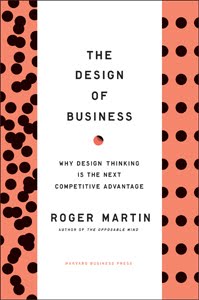
Book Review: The Design Of Business


Book Title: The Design of Business
Author: Roger Martin
Year of publication: 2009
Reviewer: Lindsay Brauer, CRS 625, Spring 2010

“The Design of Business” written by Roger Martin is a great source of collective data on various businesses that have adapted and used design thinking as a means to better their business.

Martin discusses the aspects of design thinking in the business world. Martin coins the term “knowledge funnel” and describes it as a path a business takes to create a successful product or service. The funnel is described as a great tool to help aid in the funneling in of details, implications, individual thinking processes, group thinking process and all other ideas that exist.

Martin discusses the two different parts of business; analytical thinking and intuitive thinking. Martin describes analytical thinking as:

“…Harnesses two forms of logic- deductive reasoning and inductive reasoning….the goal of this thinking is mastery through rigorous, continuously repeated analytical processes. Judgment, bias, and variation are the enemies.” (Martin, pg.5)

and describes intuitive thinking as “the art of knowing without reasoning”. Martin believes a business needs an equal amount of analytical and intuitive thinking for success. (Martin, pg. 6) The belief in the two forms of thinking is shared by Leron & Hazzan who believe that “analytical thinking is respectable by peers while intuitive is declared as illegitimate” (Leron & Hazzan, pg. 266)

The earlier definitions of design thinking was focused around the idea that it is a process for practical, creative resolution of problems or issues that looks for important future results (Simon, 1969). Stepping into the present, design thinking relays on reliability vs. validity according to Martin (pg. 26). Tim Brown from IDEO says design thinking is “a discipline, that uses the designers sensibility and methods to match people’s needs with what is technologically feasible and what a viable business strategy can convert into customer value and market opportunity” (pg 62).

Martin brings in examples of businesses we all can relate to and are familiar with, and in some cases, felt the failure and then the recovery due to design thinking. Apple, IBM, Colgate, McDonalds and Procter and Gamble are just a few of the detailed experiences each business went through prior to implementing design thinking and after.

Being able to read the background stories of some of the most popular and well-known businesses is a great motivator to prove that a business if given the right direction, can be successful. The more recent stories such as Procter and Gamble allow readers who may have been affected by the crash in stocks, to have an understanding as to what occurred and why it took so long to recover and get back on track. The reader is given the details as to what steps they took, who they went to and why.

Martin discusses for every business mentioned that when they began to recover from failure the businesses were creating an equal balance between analytical thinking and intuitive thinking. Diego Uribe’s belief in dynamic balance plays an important role in developing a successful business he states: “Dynamic balance is a state of equilibrium that emerges from the interaction between two or more forces” (Uribe, 2010).

Martin goes further with his research and discusses how exploration vs. exploitation are also factors that need to be known in order to have a successful design of business. “Quality Exploitation deals with the quality management practices that aim to control the known problems and processes…while quality exploration includes quality management practices that aim to explore the unknown and to identify and purse novel ideas/solutions” (Zhang, 2010). Martin’s concept of exploration vs. exploitation agrees with Zhang. Martin breaks down the concept each into seven parts that easily explain the purpose and the effect of each in the business world of design.

Martin speaks about the development of your own personal knowledge system, how we acquire and knowledge. He also discusses how your own personal knowledge system can be turned in to a successful business knowledge system. The importance of understanding personal knowledge system or any knowledge system is seen in research by David Chen, where his results then introduced a new concept to schools that focused on human nature and the nature of their knowledge (Chen, 2010).

The strengths of this book revolve around all the great examples of popular and well-known businesses. Not only does it allow you to see what occurred within the company before adopting design thinking, but it also gives you details of how they came about bringing design thinking to life in their business. Many of us watched on the news as some of these businesses crashed over the last few years and this book provides excellent insider information as to the business failure due to lack of design and the rebirth of the business including design. It clearly shows evidence and proof that creative thinking in a business is needed to be successful. The more businesses adapt this type of thinking and this type of creativity, the more successful they will become and the more creative and innovating products will be born.
The book lacks the instructional part of design thinking, or the step by steps as to what it is and how to successfully adopt it to any business. Although the examples were great, and had great detail as to how design thinking helped them, the book still lacked a formal review of the steps needed to successful adapt and maintain design thinking in a business. The book provides you with examples of success, but without the actual breakdown and steps needed to implement design thinking, the idea of creativity advancing seems slim without those steps being elaborated on or more clearly expressed.
Bibliography:

Chen, D. (2010). Schooling as a Knowledge System: Lessons from Cramim Experimental School. Mind, Brain and Education, 4, 8.

Uribe, D. (Director) (2010, February 22). Harvesting Dynamic Balance for a Better World.. TEDx Tampa Bay. Lecture conducted from TEDx, Tampa Bay.

Leron, U., & Hazzan, O. (2009). Intuitive vs Analytical Thinking: Four Perspectives. Springer Science + Business Media, 1, 1-15.

Martin, R. (2009). The Design of Business. Boston: Harvard Business Press.

Simon, H. (1969). The Sciences of the Artificial. Cambridge: MIT Press.

Zhang, D. (2010). Quality exploitation versus quality exploration: measurements,
antecedents and performance implications. Industrial & Organizational Psychology, 70, 2616.