
This blog will discuss the current issues in creativity by the graduate students at the International Center for Studies in Creativity at Buffalo State. www.buffalostate.edu/creativity The views expressed herein are those of the graduate students and do not necessarily represent the views of the International Center for Studies in Creativity or of any other Buffalo State College body.
Wednesday, September 15, 2010
You are not a gadget: A manifesto
Melanie Rothschild
Lanier, J. (2010). You are Not a Gadget: a Manifesto. New York, NY: Alfred A. Knopf.
I must first explain, that I consider Jaron Lanier to be something of a Cinderella figure in my life: this has nothing to do with his three-foot long dreads. Rather it harkens back to the Creativity and Cognition conference I attended in October, 2009. At that conference, I found myself deeply enthralled by an un-scheduled speaker who warned about the dangers of groupthink in the creativity community. In the middle of a thought, he suddenly remembered his unattended parking meter and bolted out of the hall. No one sitting near me knew his name and I was never able to learn his identity. Several months later, I heard Mr. Lanier interviewed on the radio about his new book and found very engrossing the issues he was discussing about maintaining individual personhood in an increasingly tech world. When I finally got hold of You Are Not a Gadget, and went to read about the author, I was astonished to see from the picture, that he was in fact, the same fellow who ran out to tend his parking meter last year in Berkeley. Ah, a fit for the glass slipper at last.
“When we deploy a computer model of something like learning or friendship in a way that has an effect on real lives, we are relying on faith. When we ask people to live their lives through our models, we are potentially reducing life itself. How can we ever know what we might be losing?” (p.70).
I have been a visitor to Mr. Lanier’s world of technological landscapes and fast flowing rivers of expertise. This destination is extremely far from my usual home, further even than Buffalo, New York. He is certainly a fascinating, if not necessarily overly welcoming host to non-techies. Nevertheless, I find him to be a profoundly good man and I am happy to hang out in his quarters for a while based on my abundant respect for his raw tech brilliance all the while connected to an ever-present awareness and concern for the experience of the human soul. His book is basically a discussion on maintaining personhood in a technological culture.
In describing him in relationship to creativity, I would probably have to say that he is the closest thing to a living embodiment of the entire concept of creativity that I can imagine. His claim to pioneering inventions and inroads in the history of technology is formidable (among many other things, he is credited with coining the term virtual reality) and he is not only a musician but also a recognized expert in early instruments. All this would certainly be enough to earn him substantial decorative hardware as a creative giant, but what speaks the loudest about his essential creative spirit I believe, is his ability to be introspective and sensitive to a myriad of potential human ramifications of this dense and intense world as well as the bravery to amplify his concerns. It would only shortchange Lanier to not extend full claim to him, all of the following titles: tech giant, musician, philosopher, anthropologist, entertainer and “humanist softie” (p.191).
While thoroughly devout to the potential of the tech world for ultimate good, he discusses a host of fundamental issues about a cybernetic totalist culture where individual human specialness would ultimately be subsumed. His concerns include the annonynimity of the web which he asserts too often denies the individual intellectual credit as well as the need for responsibility, giving rise to creating pack-like thinking. He points to Wikipedia as becoming a dominant source of reference which erases accountability and point of view entirely. The author takes the reader on a logical continuing path in which the practice of obscuring authorship could ultimately lead to “one collective book” (p.47) bankrupting us of books by individuals. He refers to a “digital flattening of expression into a global mush” (p.45). His discussion of the internet’s impact on the world of print journalism posits a critical warning about the invaluable role of an independent press, composed of “heroic voices” without which, “the collective becomes stupid and unreliable” (p.57).
He continually points out and challenges subtle strains of thought which are easily taken for granted in our rush to keep up with an ever-developing tech way of life. Lanier discusses how computers, with reputations as intelligent machines, tend to make people defer to them and become prone to changing themselves in order to appear to make the machine work better, instead of insisting that the computer be changed to be more useful (p.36).
Facebook he warns, organizes people into multiple-choice identities and points out that it is the “alien bits where the flavor is found” (p.48). By reconfiguring information to make it fit a particular pre-planned format, we risk losing the heart of it. He reminds us that the real customers of Facebook are not the members, but rather the advertisers of the future who will feed on the valuable information currently being captured (“social-graph”) between people whose definition of what constitutes a “friend” seriously diminishes prior uses of the term. A fierce believer and defender of individual creativity he states: “A new generation has come of age with a reduced expectation of what a person can be and of who each person might become” (p.4).
He believes that before vast baseline technological systems are instituted and become deeply entrenched, or “locked-in” to place, tremendous thought must go into potential outcomes:
“It is impossible to work with information technology without also engaging in social engineering . . . Different media designs stimulate different potentials in human nature. We shouldn’t seek to make the pack mentality as efficient as possible. We should instead seek to inspire the phenomenon of individual intelligence” (p.5).
“There is more than one possible technological future and the debate should be about how to best identify and act on whatever freedoms of choice we still have” (p.45). Without this careful planning, the consequences of initially inconsequential decisions can develop into “unchangeable rules of our lives (p. 8-9).” Constantly questioning what are easily perceived as established rules of the web, he makes a compelling case for the ultimate diminution of individual creativity within the framework of an endless sea of free access to creative content: without compensating individual artists even a tiny bit, we lose the effect of imposed scarcity, without which money itself has no value, a concept which is at the heart of a capitalist system.
While Lanier certainly blasts tech culture to a significant degree, he makes a touching tribute to his colleagues rather early in the text, thereby reasserting his basic core optimism in the creative spirit of the intellectual tech culture:
Many of my friends disagree with me. It is to their credit that I feel free to speak my mind, knowing that I will still be welcome in our world (p.17).
His tome, while dire at times, is impressive and even inspiring in terms of the writer’s ability to examine that of his own making as well as to introduce thinking which emboldens us to take claim of our spiritual selves and challenge what may at time seem like the inevitable. He reminds us indeed that we are each, responsible for our own creativity.

Monday, September 13, 2010
Light up your child’s mind: Finding a unique pathway to happiness and success
Book Review
Light up your child’s mind: Finding a unique pathway to happiness and success, by Joseph S. Renzulli and Sally M. Reis, with Andrea Thompson, Little Brown and Company, 2009, 304 pp., ISBN-13: 978-0-316-00398-8, $25.99.
Reviewed by Lee Anne White, State University of New York/Buffalo State.
Despite many one-size-fits-all gifted programs, gifted and talented students are not a homogenous group. They are a highly diverse group, and traditional methods of identifying students for these programs often overlook the creatively gifted. While many creatively gifted children excel in the classroom, others do not. “The answer,” Renzulli and Reis say, “lies in looking not for a ‘gifted child’ but for a child who displays or has the potential to display gifted behaviors” (p. 15). They also suggest that rather than testing for giftedness, educators and parents should focus instead on developing talent wherever they see potential—to help children build on their strengths, discover a love of learning, and develop creative problem-solving skills. In doing so, children will gain more than knowledge. They will grow in self-confidence and self-efficacy, and develop valuable life skills.
Although written for the parents of students who display gifted potential, the strategies detailed in this book can be used to help light up the minds of all children. This practical and inspiring guide is based on the premise that children learn best when they enjoy what they are doing and tackle authentic, real-life challenges. Renzulli and Reis encourage an investigative, project-based approach to learning, rather than the “drill-and-practice” approach often found in classrooms. The emphasis is on “creative-product learning,” or that which “takes place when a youngster is intent on developing an original something, a product that he hopes will have a positive impact on an audience of some kind” (p12). Such products might include an invention, a short theatrical production, a newspaper article, a small business venture, or tackling a local community issue.
This concept of creative productivity—taking education beyond the classroom environment and developing projects that tap a child’s individual interests and sense of curiosity—encourages children to develop creative problem-solving skills. And the authors emphasize that parents play a crucial role in that process by providing opportunities, resources, and encouragement.
Light Up Your Child’s Mind is divided into three sections: The first challenges the traditional concept of giftedness that is primarily based upon intelligence and testing, instead arguing that potential giftedness can be observed when high levels of ability, creativity, and motivation come together in a child. The book also addresses the hidden potential in children who daydream, challenge authority, or have one-track minds—noting that these children are often creatively gifted. The second section helps parents recognize the strengths, interests, and learning styles of their children, and offers practical strategies for guiding out-of-class learning opportunities. Anecdotes, including stories about challenges the authors faced with their own children, help bring this section to life. The final section addresses special considerations for underachievers and the twice exceptional (those with both gifts and talents, and learning disabilities), and offers tips for partnering with teachers to enhance a child’s education. The book is filled with useful sidebars—questionnaires, checklists, and activity lists—and the appendix provides extensive resources, including outstanding books, websites, and competitions that offer “active learning” activities.
What makes this book different from other books on gifted and talented education is the authors’ recognition that all children have unique strengths and interests that should be developed, that creative-production is a powerful way of both learning and instilling a lifelong love for learning, and that parents are just as responsible as educators when it comes to developing the talents of their children. It is packed with success stories and practical advice, giving parents hope and direction, as well as specific strategies they can use with their children.
Thursday, April 8, 2010
Book Review: Change by Design

Book Title: Change by Design
Author: Tim Brown
Year of publication: 2009
Reviewer: Mermaid Chang, CRS 625, Spring 2010
The book Change By Design introduced design thinking and the author, Tim Brown, contended that many innovations do not simply leap from the minds of so-called geniuses, but rather are actually created through design thinking. In this book, he encouraged us to be a design thinker who knows how to use design thinking, not just be a designer. What’s the difference? One of the biggest differences is that the works of designers are supposed to be “watched” and the works of design thinkers are supposed to be “watched, and, used”. In brief, a design thinker is making things easier to use, more attractive and more functional.
According to the book, design thinking begins with problem solving and then continues by experimentation and implementation, instead of just imagining the outcome. Brown explained that the process of design thinking is matching people’s needs, and then translating those needs into demands by a holistic approach. The result is working with human beings to understand the issues rather than just focusing on business and technology issues.
The writer contended that design thinking doesn’t just work in creative industries - that it could be adopted in other industries - since design thinking is integrated by nature: a balance of people, technology and business. People are the most important element of innovation - the human centered approach. Observing people’s behaviors, which relate to products and services, is emphasized in design thinking because Brown believed that the emotional feeling is as important as the functional performances. In another words, it is a balance between emotional and cognitive dimensions of design.
The project called “Keep the Change” created by the Bank of America in October, 2005 is a good example. The program helps their customers contribute to their savings accounts by automatically rounding up debit card purchases to the nearest dollar and transferring this difference into the customers’ saving accounts. Bank of America observed the need that people wanted (or needed) to save money so they converted this need into a demanded service by creating an easy way of saving than tossing the change into a jar.
Experimentation is also encouraged because it might help integrate the creative culture of design thinking into organizations. Brown stressed that there is nothing wrong with failure as long as it comes early and often. Organizations can still benefit from learning from failure. The best way to execute experimenting is prototyping since it’s quick, cheap and dirty. The faster we make ideas tangible, the sooner we will be able to evaluate them, refine them, and zero in on the best solution. In fact, the prototype needs to be testable, yet doesn’t need to be physical; scenarios, storyboards or acting are all good ways. One important reminder is that we need to accept the “more complex” during the process just like we say embracing the ambiguity in the creativity field. But design thinking couldn’t work without design thinkers who implement deign thinking. Find them, nurture them and free them up to do what they do best. Brown thinks those designer thinkers already exist in every industry.
The Kaiser Permanente is a case in a point. Instead of hiring a slew of internal designers, their existing staffs learn the principles of design thinking and apply them themselves to achieve organization wide change without hiring professional designers. The author is telling us that creative thinking shouldn’t just limited in the creative industry or people in the design field, it could reach to any level of organizations, products and services through design thinking.
Brown also wrote about design thinking for Harvard Business Review in June, 2008. And Nussbaum (2008) asserted it marked that the acceptance and legitimization of design/innovation as an important business process and strategic tool for managers. Besides, Tim Brown was interviewed by a magazine from Taiwan called CommomWealth. Brown stressed that how design thinking might help CEO or high managers to be keep being innovative. He suggested the first step is asking the right question and all the answers will come after observing through. Those showed that design thinking is infused into other industries.
I also recommend the cover story, “The power of design” , of Businessweek, May,17 since it is one of the articles about IDEO which could illustrated how IDEO blossomed by adopting design thinking.
As a student of creativity field, I do see a lot of similarity between CPS (Creative Problem Solving) and design thinking since design thinking adopt brainstorming, storyboard or roll playing in early stage to solve the problems. Besides, I think design thinking is more about designing an experience and an idea must be implemented with the same care to become an experience. Comparing with CPS, I think the care is the attitude in Ruth Noller’s equation and the observing process is a type of contextual thinking skill. However, design thinking emphasized the importance of developing a prototype, which CPS doesn’t stress too much except making action plan.
To sum up, I did enjoy reading the book and I believe that this book did introduce another useful process for creativity, especially for people who want to know how to implement their ideas into real works. I highly recommend it to those who want to be innovative in any field. However, the author didn’t really explain the detail methods of how to execute design thinking in the book. If you are interested, IDEO Method Cards: 51 Ways to Inspire Design(2003) will be a good choice.
References
Brown, T. (2009). Change by Design. New York: HarperBusiness.
Brown, T. (2008, June). Design Thinking. Harvard Business Review. P.84-92.
IDEO. (2003). IDEO Method Cards: 51 Ways to Inspire Design. San Francisco: William Stout
Nussbaum, B. (2004, May, 17). The Power of Design. BusinessWeek. p.86
Nussbaum, B. (2008, June, 25). IDEO's Tim Brown On Innovation In The Harvard Business Review. BusinessWeek. Retrieved from http://www.businessweek.com/innovate/NussbaumOnDesign/archives/2008/06/ideos_tim_brown.html?campaign_id=rss_blog_nussbaumondesign.
王曉玟(2009). 專訪IDEO執行長 布朗:請像設計師一樣思考.WealthCommon. Vol.421. Retrieved from http://www.cw.com.tw/article/index.jsp?id=37609.
Book Review: Mindset

Book Title: Mindset
Author: Carol Dweck
Year of publication: 2006
Reviewer: Alyssa Roberts, CRS 625, Spring 2010
Carol Dweck, author of Mindset, makes readers aware of the two opposing mindsets people have: the growth mindset and the fixed mindset, and how achieving and sustaining success follows from the growth mindset. In the growth mindset a person’s potential is unknown. The amount of achievement one can have depends on the effort put in to reach goals and how obstacles are learning tools to move forward. They believe that you don’t get something for nothing; in other words, you get out what you put in. In the fixed mindset, intelligence, ability, potential, personality, etc are all fixed traits that cannot be developed. People who think this way are constantly trying to prove themselves to others and when they fall short of their goals, give up with the reasoning that, “if it was meant to be, it would have happened.”
In relating creativity to these mindsets, one can easily see that in order to be creative, one must adopt the growth mindset. The growth mindset approaches life in the spirit of learning, growing, and opportunity. Thinking creatively and with a growth mindset complements each other and promotes a better human existence! Creativity has been linked to well-being and successful adaptation to the demands of daily life (Puccio, Firestien, Coyle, & Masucci, 2006). A growth mindset facilitates this because the setbacks, which are inevitable in life, seem less of a roadblock if they are seen as an opportunity to learn. In a fixed mindset roadblocks signify the end of the road. Setbacks and failure define the person and do damage to self-esteem and future effort. There is no place for a fixed mindset attitude in creativity because it squelches creative thought, and leaves no room for growth, improvement, and change.
The characteristics of a creative person and a person who has a growth mindset are very similar. Openness to novelty and tolerance for ambiguity and complexity are effective skills in creative problem solving (Puccio & Cabra, 2007). People with a growth mindset are capable of this flexibility, level of tolerance, and limited control. In a growth mindset, divergent thinking comes naturally because the person is willing to test and learn from his/her mistakes, and use the results to think of something better. Each failure is an opportunity to learn. When Edison was working on the light bulb, it did not all come together in a flash and without the help of others. Someone commented that it was a shame he had tried “50,000” things that didn’t work, to which Edison replied that he had lots of results! He knew several things that wouldn’t work (Puccio, Murdock, & Mance, 2007). He had a growth mindset and learned from the mistakes to continue on.
People with a fixed mindset cannot help but stifle creative thoughts! In fact CEOs actually punished and fired people for questioning them and trying to be innovative for the company because it jeopardized their success. They needed to bring others down to feel validated. The need to prove their superiority killed their own enjoyment in their work and stifled their creativity. People with a fixed mindset have no ability to defer judgment because they feel they should be right the first time. They only need one idea, and if it’s right- great. If it’s not, then there is no turning back to try again. This is because if they were smart and capable they would have gotten it right the first time. Therefore the problem is either unsolvable or the thinker is incompetent, or some other excuse could be listed here as to why the problem is not solved. To someone with a fixed mindset, creativity, talent, intelligence, athleticism etc. are all fixed because you either have it or you don’t. They believe that if it was meant to be or happen, it should be or happen almost by magic! They think if they fail, they cannot change and become better. It cannot be taught. If I’m not good at it now, it cannot really change. Contrary to Dweck, Gary Davis says that some highly successful people like Walt Disney were born with some special talent that even with training cannot be matched (Davis, 2004). Dweck would argue that you could be as good as you wanted to be! She gives many examples of ordinary people like Marva Collins, a master teacher and learner, and athletes, such as Michael Jordan, that have gotten to the top by hard work, persistence, and passion.
We start learning soon after we are born and those close to us push us towards one mindset or the other. Teachers and parents mean well, but exhibit a fixed mindset when they praise product over effort. Reinforcing effort says that even if something’s not right, it can be fixed! There is an opportunity to grow if you don’t succeed, and that in order to get better you must fail. A fixed mindset doesn’t not allow the students to think creatively because they are too worried about their self being judged. It’s not that an idea is bad, it’s more that they themselves are not good. Growth minded students think, if at first you don’t succeed, try try again. It is important to remind students that they are in school to learn! They shouldn’t automatically know everything because then they wouldn’t be there. From this early age we must intrinsically motivate them as this will promote creative expression and a growth mindset. Surprisingly, there is research to suggest that creative people are also extrinsically motivated by professional achievement and recognition, with the thinking that “their work is a key aspect of their identity...” (Byrne, Mumford, Barrett, & Vessey, 2009). After reading Mindset, I am weary of the people working with these end goals in mind as it is very characteristic of the fixed mindset. Are they motivated only by being better than others and keeping a status? Is their identity in life defined by their work? What happens when they don’t produce?
In Dweck’s book, the reader can see how important an attitude or mindset is to creative advancement. With the many examples she gives of business leaders, coaches, athletes, and teachers it is easy for the reader to recognize people they know or maybe positions they’ve taken in their life in terms of the two mindsets. Successful companies built upon creativity like IDEO rely on the growth mindset. Even the CEO feels no need to prove himself and is an active member of the group to get the job done. Things would never improve if people’s self esteems were at risk or if it was impossible for them to learn from their mistakes. Personally, the book made me challenge the way I think about my failures and what I am doing to learn from them and how they affect my future endeavors. If this book can effect others the way it effected me, we would have a much more productive society with a focus on creative change.
References
Byrne, C.L., Mumford, M.D., Barrett, J.D., Vessey, W.B. (2009). Examining the leaders of creative efforts: What do they do, and what do they think about. Creativity and Innovation Management, 18(4), 256-268.
Davis, G.A. (2004). Creativity is forever (5th ed.). Dubuque, IA: Kendall/Hunt.
Puccio, G.J., Firestien, R.L., Coyle, C. & Masucci, C. (2006). A review of the effectiveness of CPS training: A focus on workplace issues. Creativity and Innovation Management, 15(1), 19-33.
Puccio, G.J., Murdock, M.C., Mance, M. (2007). Creative leadership: Skills that drive change. Thousand Oaks, CA: SAGE.
Puccio, G. J., & Cabra, J. F. (2009). Creative problem solving: Past, present and future (327-337). In T. Rickards, M. Runco, & S. Moger (Eds.), The Routledge Companion to Creativity. Oxford, UK: Routledge.
Book Review: A fine line: How Design Strategies are Shaping the Future of Business

Book Title: A fine line: How Design Strategies are Shaping the Future of Business
Author: Harmut Esslinger
Year of publication: 2009
Reviewer: Deedee Clohesy, CRS 625, Spring 2010
“I understood very early on that businesses need creativity like humans need oxygen, and I was able to convince my clients that they needed to ‘breathe’ in order to flourish” (Esslinger, 2009, p. xii).
By all accounts, frog design, inc. has done everything right. In his book Fine Line: How Design Strategies are Shaping the Future of Business, frog’s founder, Hartmut Esslinger, takes readers on a personal and professional journey through forty years of cutting-edge design thinking, creative strategies, and innovative problem-solving. Remaining down to earth and surprisingly un-pompous, Esslinger’s narrative is straightforward and informative from both a design and a business perspective, and offers invaluable insight to anyone looking for an insider view of the industry and how design and business principles can be combined for greater force within it.
While still a student, Esslinger had an experience – a rejection in a design competition – that served as an epiphany. Dismissing the current world of design as a stiff and limiting hierarchy, he founded his first design firm, esslinger design (Esslinger purposely did not capitalize the name), in 1969 with one simple vision: that design could be relevant to business and industry and be redefined as a strategic profession. He formulated a six-step, simple but ambitious plan that included working for the client rather than for himself and always looking for the best people when it came to not just business partners and employees, but in clients, too. Providing the best for the best was, in Esslinger’s plan, the way to success. And it worked.
Founding frog (again, no capitalization, as a purposeful rebellion against grammatical rules) shortly thereafter, Esslinger formed a business relationship with Steve Jobs of Apple Computer and created the “Snow White language” that would serve as the basis for Apple’s revolution and a precursor for Apple’s present-day colossal market presence.
Leadership, to Esslinger, was the hinge upon which a company’s success could swing. Principles and vision and strategy were all part of success, but without effective leadership, nothing else could work. Having witnessed the implosion of Apple after Jobs’ dismissal in 1985, he attributed the ensuing dysfunction on lack of foresight and poor leadership. Leaders, Esslinger said, are obligated to make all the right decisions – for their company, its employees, its shareholders, their families, and the local economy; it’s what Tim Brown (2008) of IDEO calls “the people first approach” (87). The most important factors in effective leadership are the desire to explore the unknown, to be willing to take risks, and above all – flexibility. Creative strategy is flexible. So must be its leaders. Frog’s motto, in fact, is Change Is Fun (Esslinger, 2009).
In 2008, Amabile and Khair wrote an article for the Harvard Business Review, in which Amy Edmunson, a professor at Harvard, stressed management’s role in creating a psychologically safe environment in order to foster trust and creativity. Esslinger obviously built frog on this principle, yet was focused and confident, wielding what Jack and Suzy Welch (2007) referred to "The Velvet Hammer” (116) – the firm but gentle approach to managing creative personalities.
Esslinger moves through the various schools of thought in the design world, pointing out the importance of choosing the right creative partner for the job. His strategy was nothing new; domain specificity and interdomain creativity differences have been studied by researchers and scholars like Howard Gardner for years. Donald MacKinnon’s seminal research into the ego, personalities, and self-images of architects in the 1960’s laid solid ground for such theory. (Runco, 2007). Esslinger recognized this and worked it into his success. Putting, for example, a classic designer like Dieter Rams on a project more suited for an artistic designer such as Ross Lovegrove was, to Esslinger, counterintuitive and an irresponsible way to run things. Frog’s strategy, nonetheless, is still one of holistic design, of “strategic designers who are fluent in convergent technologies, social and ecological needs, and business”(p. 53). Like Pixar’s Ed Catmull (2008) noted about his company’s peer culture and creative process, “everyone is fully invested in helping everyone else turn out the best work” (p.69).
References
Amabile, T. and Khaire, M. (2008, October). Creativity and the role of the leader. Harvard Business Review. 101-109.
Brown, T. (2008, June). Design thinking. Harvard Business Review. 84-92
Catmull, E. (2008, September). How Pixar fosters collective creativity. Harvard Business Review. 65-72.
Runco, M. (2007). Creativity theories and themes: research, development, and practice. Burlington, MA: Elsevier.
Welch, J. and Welch, S. (2007, September 27) Wielding the velvet hammer . Business Week. 4051. 116. Retrieved from http://proxy.buffalostate.edu:2076/ehost/detail?vid=1&hid=103&sid=1de8d40e-39a5-4eaa-8922-dfda0734d155%40sessionmgr111&bdata=JnNpdGU9ZWhvc3QtbGl2ZQ%3d%3d#db=voh&AN=26607500
Book Review: The Design Of Business
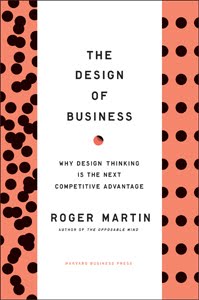
Book Title: The Design of Business
Author: Roger Martin
Year of publication: 2009
Reviewer: Lindsay Brauer, CRS 625, Spring 2010
“The Design of Business” written by Roger Martin is a great source of collective data on various businesses that have adapted and used design thinking as a means to better their business.
Martin discusses the aspects of design thinking in the business world. Martin coins the term “knowledge funnel” and describes it as a path a business takes to create a successful product or service. The funnel is described as a great tool to help aid in the funneling in of details, implications, individual thinking processes, group thinking process and all other ideas that exist.
Martin discusses the two different parts of business; analytical thinking and intuitive thinking. Martin describes analytical thinking as:
“…Harnesses two forms of logic- deductive reasoning and inductive reasoning….the goal of this thinking is mastery through rigorous, continuously repeated analytical processes. Judgment, bias, and variation are the enemies.” (Martin, pg.5)
and describes intuitive thinking as “the art of knowing without reasoning”. Martin believes a business needs an equal amount of analytical and intuitive thinking for success. (Martin, pg. 6) The belief in the two forms of thinking is shared by Leron & Hazzan who believe that “analytical thinking is respectable by peers while intuitive is declared as illegitimate” (Leron & Hazzan, pg. 266)
The earlier definitions of design thinking was focused around the idea that it is a process for practical, creative resolution of problems or issues that looks for important future results (Simon, 1969). Stepping into the present, design thinking relays on reliability vs. validity according to Martin (pg. 26). Tim Brown from IDEO says design thinking is “a discipline, that uses the designers sensibility and methods to match people’s needs with what is technologically feasible and what a viable business strategy can convert into customer value and market opportunity” (pg 62).
Martin brings in examples of businesses we all can relate to and are familiar with, and in some cases, felt the failure and then the recovery due to design thinking. Apple, IBM, Colgate, McDonalds and Procter and Gamble are just a few of the detailed experiences each business went through prior to implementing design thinking and after.
Being able to read the background stories of some of the most popular and well-known businesses is a great motivator to prove that a business if given the right direction, can be successful. The more recent stories such as Procter and Gamble allow readers who may have been affected by the crash in stocks, to have an understanding as to what occurred and why it took so long to recover and get back on track. The reader is given the details as to what steps they took, who they went to and why.
Martin discusses for every business mentioned that when they began to recover from failure the businesses were creating an equal balance between analytical thinking and intuitive thinking. Diego Uribe’s belief in dynamic balance plays an important role in developing a successful business he states: “Dynamic balance is a state of equilibrium that emerges from the interaction between two or more forces” (Uribe, 2010).
Martin goes further with his research and discusses how exploration vs. exploitation are also factors that need to be known in order to have a successful design of business. “Quality Exploitation deals with the quality management practices that aim to control the known problems and processes…while quality exploration includes quality management practices that aim to explore the unknown and to identify and purse novel ideas/solutions” (Zhang, 2010). Martin’s concept of exploration vs. exploitation agrees with Zhang. Martin breaks down the concept each into seven parts that easily explain the purpose and the effect of each in the business world of design.
Martin speaks about the development of your own personal knowledge system, how we acquire and knowledge. He also discusses how your own personal knowledge system can be turned in to a successful business knowledge system. The importance of understanding personal knowledge system or any knowledge system is seen in research by David Chen, where his results then introduced a new concept to schools that focused on human nature and the nature of their knowledge (Chen, 2010).
The strengths of this book revolve around all the great examples of popular and well-known businesses. Not only does it allow you to see what occurred within the company before adopting design thinking, but it also gives you details of how they came about bringing design thinking to life in their business. Many of us watched on the news as some of these businesses crashed over the last few years and this book provides excellent insider information as to the business failure due to lack of design and the rebirth of the business including design. It clearly shows evidence and proof that creative thinking in a business is needed to be successful. The more businesses adapt this type of thinking and this type of creativity, the more successful they will become and the more creative and innovating products will be born.
The book lacks the instructional part of design thinking, or the step by steps as to what it is and how to successfully adopt it to any business. Although the examples were great, and had great detail as to how design thinking helped them, the book still lacked a formal review of the steps needed to successful adapt and maintain design thinking in a business. The book provides you with examples of success, but without the actual breakdown and steps needed to implement design thinking, the idea of creativity advancing seems slim without those steps being elaborated on or more clearly expressed.
Bibliography:
Chen, D. (2010). Schooling as a Knowledge System: Lessons from Cramim Experimental School. Mind, Brain and Education, 4, 8.
Uribe, D. (Director) (2010, February 22). Harvesting Dynamic Balance for a Better World.. TEDx Tampa Bay. Lecture conducted from TEDx, Tampa Bay.
Leron, U., & Hazzan, O. (2009). Intuitive vs Analytical Thinking: Four Perspectives. Springer Science + Business Media, 1, 1-15.
Martin, R. (2009). The Design of Business. Boston: Harvard Business Press.
Simon, H. (1969). The Sciences of the Artificial. Cambridge: MIT Press.
Zhang, D. (2010). Quality exploitation versus quality exploration: measurements,
antecedents and performance implications. Industrial & Organizational Psychology, 70, 2616.
Book Review: Creative Recovery: A Complete Addiction Treatment Program That Uses Your Natural Creativity

Book Title: Creative Recovery: A Complete Addiction Treatment Program That Uses Your Natural Creativity
Authors: Eric Maisel, PhD and Susan Raeburn, PhD
Year of publication: 2008
Reviewer: Jenna Ziegler, CRS 625, Spring 2010
While Maisel and Raeburn directed Creative Recovery towards a specific population, that being creative people who are suffering from addiction, that is not to say that the definitions and explanations provided in this volume couldn’t be valuable to readers of varying perspectives. One such perspective is the reader who is looking to understand the illness that is addiction. For that reader, Maisel and Raeburn outline several aspects of addiction including types of addictions, the addiction spectrum, and the types of risk factors that contribute to addictive behavior. Enter creativity. The authors explain how being a creative person is in itself a risk factor for addiction and how the creative person is more susceptible to addiction due to some of the characteristics determined to be typical of the creative personality. Rather than diving into the immense body of research that has been done about the creative personality, the authors cite one trait in particular that they assert contributes to addiction the most: individuality. According to the authors, the more than 75 traits that are related to the creative personality all flow from individuality. It is traits like these that come together to make the creative person more prone to addiction as they attempt to express their individuality. In his studies of personality, Gary Davis (2004) categorized over thirty personality traits that can be attributed to or fall under the heading of “independent.” One of these traits is “individualistic”, and it is not a far stretch to see how the others listed in the category can contribute to one’s sense of individuality, such as outspoken, uninhibited, and strong willed. Other traits that make the creative person vulnerable to addiction, as described by the authors and supported by Runco (2007) include an openness to experience as well as an attitude of non-conformity. A person who is open to a wide variety of experiences may also suffer from issues of self-control which have also been linked to addictive behaviors (Miller, 2007). Clearly, the assertions that the authors make to support the creative person as more prone to addiction than their non-creative counterpart are rooted in several personality studies and hefty personality research. In summary, the authors successfully illustrate that there are many overlaps between the creative personality and the addictive personality.
After giving a background on addiction - its meaning, its warning signs, and its risk-factors - the authors dedicate the remainder of the book to outlining an addiction recovery program geared towards the risks faced particularly by the creative person. It is in these steps that the authors forfeit some of their readers by defining creativity rather narrowly. In the beginning of the book, Maisel and Raeburn (2008) describe what they believe to be the creative person and essentially define creativity. In their opinion, the creative person is:
a sensitive, intelligent, thoughtful, ethically responsible person with a deep desire to actualize [their] potential; someone who responds to beauty and is interested in beauty; a person with a strong sense of individuality who nevertheless needs to make more-than-just-me connections; someone who would love to live an artful, art-filled, and possibly art-committed life that feels rich and authentic (p. 3).
While this definition begins broad and seems to include creative endeavors of all kinds by simply defining the creative person, it ends by restricting creativity as pertaining to arts and aesthetics. What follows in the remainder of the book is an outline of a recovery program that is based on this definition and tailored to the type of creative person defined above. At the conclusion of each chapter the authors provide exercises designed for the various types of creative people, intended to reinforce the particular aspect of the recovery program they described in that chapter. While they do indeed make use of the reader’s creativity, the exercises, which are directed toward dancers, musicians, writers, visual artists, and scientists, limit the ways in which people in other creative fields could benefit from their recovery program. The one way in which the authors compensate for this is by offering one last set of exercises, vaguely directed at “the dreamer.” This works as a “catch-all” for those creative people that do not fit into the categories listed above.
The final section of this book deals with maintaining sobriety and overcoming the challenges that stem from the need to create. This section, which has the benefit of being proactive, discretely calls upon some rather robust principles of creativity. One of these principles in disguise is the need to live an authentic life. The authors describe an authentic life as one which is ethical, passionate and creative, and one in which we strive for personal integrity. This description is very reminiscent of the self-actualized life described by Maslow (1968). Another principle stressed by the authors comes in the form of a caveat. In order to avoid relapse, the authors recommend a careful, reflective balance of our creative personality, the creative work itself, and the world in which we find ourselves creating. It is just as important that we pay attention to the ways we work through the creative process and to those steps that might be the most troublesome to us and therefore threaten sobriety. It is easy to see how closely these elements resemble the model of creativity presented by Rhodes (1987) and how equal attention to each aspect - person, product, process, and press - is necessary in order to live a sober life that is free of relapse. As implied in any system model, neglect of any one of these pieces can threaten the health of the whole, which in this case is the sobriety of the person involved.
By no means do the authors purport that addiction is restricted to those members of the population that show creative tendencies. Instead, they put forth the idea that since certain aspects of the creative person make him or her more likely to fall victim to addiction, then there ought to be a recovery program that takes these aspects into account and is designed particularly with this person in mind. Throughout this text, the authors examine addiction with creativity as the backdrop. Though their definition of creativity might exclude some creative people from reaping the full benefit of their program, there are several arguments, steps, suggestions, and considerations that can be taken to heart by any person seeking to recover from addiction or aid a loved one who is.
References
Davis, G. (2004). Creativity is forever. Dubuque, IA: Kendall/Hunt.
Maisel, E. & Raeburn, S. (2008). Creative recovery: A complete addiction treatment program that uses your natural creativity. Boston: Shambhala Publications, Inc.
Maslow, A. (1968). Toward a psychology of being. New York: John Wiley & Sons.
Miller, W. R. (2007). Is addiction a problem of self-control? In J. E. Henningfield, P. B. Santora, and W. K. Bickel (Eds.), Addiction Treatment: Science and Policy for the Twenty-first Century (pp. 19-23). Baltimore: The Johns Hopkins University Press.
Rhodes, M. (1987). An analysis of creativity. In S. G. Isaksen (Ed.), Frontiers of creativity research: Beyond the Basics (pp. 216-222). Buffalo: Bearly Limited.
Runco, M. A. (2007). Creativity: theories and themes, research, development, and practice. New York: Elsevier Academic Press.
Subscribe to:
Posts (Atom)